Friday, 29 January 2010
Simplexity
The world as a whole is complex, but it is also a unity. It is “simplex”, founded on simple principles. Poets, painters, scientists and mathematicians are all searching for simplexity in their own way. Aesthetic pleasure is very largely the delight we feel in seeing order, meaning and relationship – the beauty that Coleridge called unity in variety. But it has to be an order unforced, seemingly spontaneous, rather than brutally imposed upon the material. The world as a whole is beautiful in just this sense.
Modern science describes the world as to a large extent “self-organizing”, because sophisticated and unpredictable patterns are now thought to emerge spontaneously from the indefinite repetition of simple algorithms. Furthermore they do so without violating the law of entropy. Evolution is then held to account for the refinement of those patterns through the process of selection. None of this - if true - is incompatible with theism (although it makes Intelligent Design look a bit foolish). The Christian God is the principle of existence itself, the creator without whom there would be nothing either simple or complex to admire. (For the compatibility of theistic faith with an up-to-date cosmology see Stephen Barr’s Modern Physics and Ancient Faith, reviewed here.) If with complexity emerges unpredictability, this merely highlights the possibility of a higher-level order we call providence, governing coincidence and chance. God is the principle of order, and thus the ever-present source of unity as well as diversity.
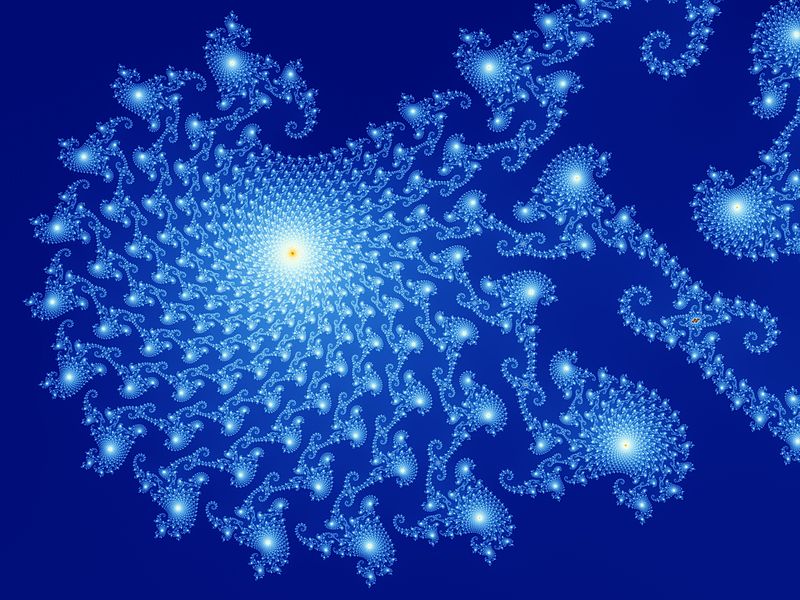
If science interests you, take this awesome trip through the known universe. (The image above, by the way, is a fractal from Wikimedia Commons. For more on fractals see this clip on fractals in Africa.)
Labels:
beauty,
complexity,
fractals,
science,
simplicity
Tuesday, 19 January 2010
Music of Creation in Tolkien
“There's a divinity that shapes our ends, Rough-hew them how we will." (Hamlet V.II.)
Both C.S. Lewis and J.R.R. Tolkien saw the creation of the world as taking place in some way through music. Readers of the Narniad will recall Aslan singing Narnia into being in The Magician’s Nephew. As for Tolkien, he composed a whole “Elvish Book of Genesis” in the form of the Ainulindale, the opening section of the posthumously published Silmarillion, describing the creation of the world by the One God (Illuvatar). In that mythological account – which he believed to be compatible with the creation story in Genesis – God first proposes the world as a musical theme, which
Labels:
Bouyer,
Coomaraswamy,
Elves,
Genesis,
Tolkien
Sunday, 17 January 2010
Sacred Music
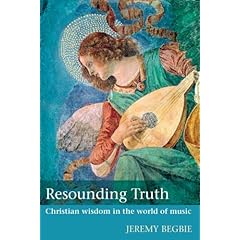
In Beauty for Truth's Sake I introduce the subject of music but for those who wish to go more deeply into it I recommend Jeremy Begbie's Resounding Truth (2007). You may also like to read an article in First Things by David P. Goldman, called "Sacred Music, Sacred Time". Goldman argues that there are objective criteria for achieving a musical form that raises our minds and hearts towards God:
Whether it is Bach or Mozart that we hear in church, we have a sense in either case of what Gloria Dei, the glory of God, means. The mystery of infinite beauty is there and enables us to experience the presence of God more truly and vividly than in many sermons,” wrote Benedict XVI in his book The Spirit of the Liturgy (2000). Simpler music can foster camaraderie among worshipers and even communal joy. Authentically sacred music does more: It inspires awe, even fear.
Labels:
the sacred,
tonality,
Western music
Tuesday, 5 January 2010
Catholic Church Architecture
I have just been reviewing the most gorgeous book for the next issue of Second Spring journal (an issue on "theology of the body" that will be out in the spring). It is by Denis McNamara of the Liturgical Institute, and is called Catholic Church Architecture and the Spirit of the Liturgy. Though it looks like a coffee-table book, it is a feast for the mind and heart as well as the eyes, and completely complementary not only to David Clayton's work, mentioned elsewhere on this site, but to the many brilliant books of Scott Hahn (who wrote the Foreword) and the "new wave" of liturgical writers inspired by Ratzinger's The Spirit of the Liturgy to recover symbolism, cosmology, and the principles of sacred tradition.
The key principle is this: “Architecture is the built form of ideas, and church architecture is the built form of theology.” “As go the ideas, so goes the architecture.” No wonder things went off the rails in the 1960s. “We call things beautiful when they reveal their ontological ‘secret’, the invisible spiritual reality of their being as objects of understanding.” What makes this book much more than an exhortation, or a manifesto, or a philosophical treatise, is the precise and careful thinking that has gone into the rules of beauty, which follow in large part from this definition. We may “like” a church that reminds us of a comfy living room or Swiss chalet or an aircraft hanger, but that doesn’t make it “beautiful”; it doesn’t make it look like a “real church”. Thanks to this book, future generations are more likely to have real churches in which to worship.
If this subject interests you, you'll probably also enjoy Jean Hani's The Symbolism of the Christian Temple and Stephen J. Schloeder's Architecture in Communion.
The key principle is this: “Architecture is the built form of ideas, and church architecture is the built form of theology.” “As go the ideas, so goes the architecture.” No wonder things went off the rails in the 1960s. “We call things beautiful when they reveal their ontological ‘secret’, the invisible spiritual reality of their being as objects of understanding.” What makes this book much more than an exhortation, or a manifesto, or a philosophical treatise, is the precise and careful thinking that has gone into the rules of beauty, which follow in large part from this definition. We may “like” a church that reminds us of a comfy living room or Swiss chalet or an aircraft hanger, but that doesn’t make it “beautiful”; it doesn’t make it look like a “real church”. Thanks to this book, future generations are more likely to have real churches in which to worship.
If this subject interests you, you'll probably also enjoy Jean Hani's The Symbolism of the Christian Temple and Stephen J. Schloeder's Architecture in Communion.
Labels:
architecture,
church,
liturgy
Saturday, 2 January 2010
The Mystery of One
Yesterday was the first day of a new decade. The image of two overlapping circles and ten triangles is a geometrical way of representing the interplay between numbers - Ten emerging from One via Two. Thus One is the first number in the Decad. Or is it? In p. 56 of the book I mention that, according to the Pythagorean tradition, One is not a number but the "number beyond number". Saint Maximus the Confessor inherits and explains this tradition, according to this passage by Hans Urs von Balthasar, taken from his book Cosmic Liturgy (pp. 113-14):
Subscribe to:
Posts (Atom)