Friday, 3 June 2011
The Lord of the Rings for homeschoolers
At a recent Tolkien-related event in Italy I was speaking about the theme of "friendship" in The Lord of the Rings. In a way it is could be called a central theme, since the story is all about a Fellowship. Of course the novel is about many other things as well. Tolkien himself said it was about Death and Immortality, and on another occasion that it was about "the ennoblement of the humble" (e.g. Sam Gamgee and the Hobbits). But it is also about Marriage, Myth and reality, Heroism and Virtue, Temptation and Freedom, Power (true and false), Beauty, Technology, Nature, Creativity, Social Order, the Fall, and Language.... The novel could also be used quite naturally by home-schoolers to get children interested in and thinking about Geography, History, Ethics, Politics, Language, Poetry, Natural History, Mythology, and Philosophy. Is anyone interested in hearing more about this idea?

Monday, 25 April 2011
New Evangelization through Drama
 |
| The Quality of Mercy |
Philosophy is unavoidable, of course. As Chesterton long ago noted, everyone is a philosopher; whether you unconsciously absorb your philosophy from somewhere else (such as the newspapers) or think it through for yourself. And how you think about things shapes the way you act and behave, so nothing is richer in practical implications (even for art). Do you believe in God? But what kind of “God” is being talked about? What does the word mean to you? I have tried to address that question online here, and the main Second Spring web-site contains many useful articles on philosophical topics. Nevertheless, philosophy is never going to be a very effective means of evangelization. People open their minds, or change them, for other reasons than a good argument. “Heart speaks unto heart”, not head unto head, as Newman realized. The Christian faith places us under an obligation to communicate it where possible. But effective communication involves the imagination and the spirit, not just the reason or the intelligence.
Just as we cannot separate the virtues of faith, hope, and love, so we cannot separate truth, goodness, and beauty. It is the heart where they join together. The way we live and the beauty we produce are the most eloquent expression of the truth we believe. You cannot communicate a truth that has not changed you, and we are changed only by a truth that we recognize as in some way beautiful.
Sunday, 27 March 2011
Paying attention

“Never in any case whatever is a genuine effort of the attention wasted. It always has its effect on the spiritual plane and in consequence on the lower one of the intelligence, for all spiritual light lightens the mind.” An attempt to grasp one truth – even if it fails – will assist us in grasping another. “The useless efforts made by the Cure d’Ars, for long and painful years, in his attempt to learn Latin bore fruit in the marvellous discernment that enabled him to see the very soul of his penitents behind their words and even their silences.”
Attention is desire; it is the desire for light, for truth, for understanding, for possession. It follows, according to Weil, that the intelligence “grows and bears fruit in joy”, and that the promise or anticipation of joy is what arouses the effort of attention: it is what makes students of us.
Thursday, 24 February 2011
Newman on Higher Education
.jpg)
When Archbishop Cullen appointed Newman as Rector of the proposed Catholic University of Ireland in 1851, it was to spearhead the Church’s response to a scheme designed to enable Catholics to obtain degrees within the secular, utilitarian system devised by Sir Robert Peel: the Queen’s Colleges of Belfast, Cork and Galway. As Newman wrote, the University was intended to attract American as well as Irish students, and to become a centre of Catholic cultural renewal for the whole English-speaking world, “with Great Britain, Malta (perhaps Turkey or Egypt), and India on one side of it, and North America and Australia on the other.” It was an extraordinary vision, and even if this first Irish Catholic university was reabsorbed by the secular system after Newman’s departure, it had provided the occasion for a series of discourses on education (The Idea of a University) which continue to influence Catholic thinking today. John Paul II’s Ex Corde Ecclesiae (1990), defining the basic constitution of a modern Catholic university, clearly bears the mark of Newman’s thought.
Today, Newman’s ideas are more urgent and relevant than ever. Zenit has recently published a useful series of articles on this theme by Fr Juan R. Velez ("Newman's 'Idea' for Catholic Higher Education", Part 1, Part 2). The tensions between “liberal” or progressive and “conservative” or authoritarian elements in the Catholic academic world tend to come to a head over the
Wednesday, 16 February 2011
Fractals
 Fractals are infinitely complex and beautiful patterns produced through the repetition of a simple formula or shape, patterns which often appear rough or chaotic and which can be found everywhere in nature (the surface of the sea, the edge of a cloud, the dancing flames in a wood fire). I have written about them briefly before.
What appeals to us in such patterns, perhaps, is the combination of simplicity and complexity. They allow our minds scope to expand, and our imaginations to take off in the direction of the infinite, but at the same time to rest in a unity. It is similar to the reason we love science. Scientists are seeking the simple secret at the heart of the complex - the formula or combination of universal laws that governs all of reality and explains why it works or appears the way it does.
Something similar is happening in art, when the artist seeks unity of concept or meaning or mood in a complex scene or sight or landscape.
Not all beauty is produced by these "recursive algorithms" or the repetition of self-similarity at different scales of magnitude. Sometimes a pattern is just there in the thing and does not repeat itself. But beauty always has something to do with order, which means the finding of a unity of form in something complex - a balance between the Many and the One. The finding of unity gives us joy (which is why we call it beautiful) because it enables us to recognise the Self in the Other, outside ourselves. It causes us to expand our boundaries to include the other thing as grasped and understood, or at least as situated in a relationship to us. Fractal patterns are a version of that experience. We sense the unity, but because it is expressing itself as never-ending complexity, it never gets boring.
Therefore all beauty, including fractal beauty, reminds us of God, who is both infinitely simple (in himself, as pure love) and yet infinitely complex (in what he contains and creates).
Tuesday, 15 February 2011
Child-centred education: 3
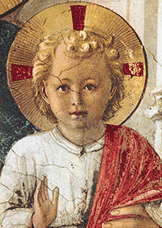
Christianity has given a particular importance to childhood. It certainly transformed, over time, the way children were perceived in classical civilizations. From the statement of Christ, “Whoever does not receive the kingdom of God like a child shall not enter it” (Mk 10:15), it followed that there was something valuable and to be imitated in the state of childhood. Normally children are told to grow up and become like adults, not the other way around. Childhood is an undeveloped stage, but in some ways it also represents a more perfect state, in which we
Subscribe to:
Posts (Atom)