Saturday, 31 December 2011

2012: probably NOT the end of the world

Prophecies of the end of the world in 2012 are based on a misreading of the Mayan calendar. This is pointed out in Robert Bolton's excellent study of the cycles and philosophy of time, The Order of the Ages. Himself a Catholic Neoplatonist, Dr Bolton examines the various calendrical systems and prophecies of different ancient civilizations, finding a number of significant convergences, indicating the possible end of a cycle of history (NOT "the end of the world") towards the end of the present century. The Mayan calculation is complicated, but if Dr Bolton is right we should take the Mayan "year" of 360 days as a symbolic round number. The Mayans were as aware as anyone of the fact that a solar year was a few days longer than this, and if this fact is taken into account the end of the present cycle would come around 2087, according to their calendar.

Of course, this kind of speculation will not convince or even interest most people, but some would like to go further and explore the prophecies of the Book of Revelation, comparing these to the messages of the various apparitions and visionaries approved by the Church (Fatima, La Salette, and so on). For those readers, Emmett O'Regan's book Unveiling the Apocalypse will be a delight. In it he even goes in some depth into the ancient number symbolism of the Bible, called Gematria. His website (follow the link I just gave) gives further material and offers a sample chapter of the book. Some of these topics, such as Gematria, also come into my book All Things Made New, although unlike O'Regan in my "spiritual" interpretation of the Apocalypse I don't refer to extra-scriptural prophecies and I don't come to conclusions that relate to specific dates and historical events.

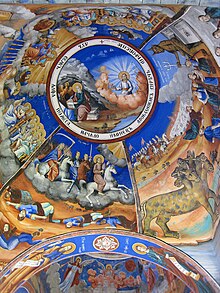
Illustration: Fresco from Osogovo Monastery, Macedonia (Wikimedia Commons)

Tuesday, 27 December 2011

A mystic in New York

"Remember"
If you go to New York, and have any interest either in art or in mysticism, do visit the Nicholas Roerich Museum, tucked away in a brownstone building up on 319 West 107th Street. Roerich was a Russian-born artist, spiritual teacher, and peacemaker – a collaborator with Diaghilev and Stravinsky – whose paintings explore the myths and symbols, the natural beauty, and the spiritual strivings of humanity around the world. The Museum displays approximately two hundred of these

Saturday, 24 December 2011

What's in a landscape?

In a previous post some time ago I mentioned G.K. Chesterton's aversion to impressionism, with which I did not quite agree. I want to look now at some landscape art that I find particularly inspiring, both to recommend it to your attention and to investigate a little for my own sake why I find it so appealing. I begin with a group of artists known as THE GROUP OF SEVEN or Algonquin School, whose work is being exhibited at the Dulwich Picture Gallery until 8 January. Unfortunately I will miss the exhibition, but do go if you can. The artists in this group were born or lived in Canada from the end of the

Wednesday, 21 December 2011

Social network

Billed as the "social network of the JP2 and B16 generations", Ignitum Today seems well worth a visit.

Thursday, 15 December 2011

Weaver on Education

A superb essay by Richard M. Weaver is featured by "The Imaginative Conservative", one of the blogs I recommend. Please read it if you have the time.

Monday, 12 December 2011

Faith formation

Some readers might not be aware that I am currently working on two other blogs, which explains why postings are a bit slow on this one for the time being. One of them is on Catholic social teaching (The Economy Project). The other is about the Christian mysteries (All Things Made New), and currently features a series on the revival of "mystagogy", or faith formation through the study of symbolism and sacraments and liturgy.