Friday, 6 January 2012

Self-creation

Lord Rees, the Astronomer Royal and former President of the Royal Society writes in an article about manned spaceflight in the Daily Telegraph (10 January):
"Even though manned spaceflight will be a diminishing priority for governments, I believe and hope that some people now living will walk on Mars (though they may well go with one-way tickets). Moreover, a century or two from now, intrepid adventurers may be living independently from the Earth. Whatever ethical constraints we impose here on the ground, we should surely wish such pioneers good luck in genetically modifying their progeny to adapt to alien environments.
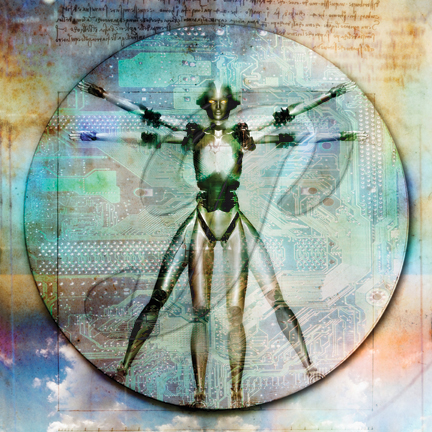
"Indeed, this might be the first step towards divergence into a new species: the beginning of the post-human era. Meanwhile, machines of human-like intelligence could spread still further into the stars. Whether the distant future lies with organic post-humans or with such intelligent machines is a matter for debate – but these prospects remind us that we may be near the beginning of a cultural and technological evolution that will continue not only here on Earth, but far beyond."
The emphasis is mine. Meanwhile, one of the most horrifying articles in a

Tuesday, 3 January 2012

Pope on education

The Pope's Message for the World Day of Peace (1 Jan.) this year is titled "Educating Young People in Justice and Peace", and section 3 in particular contains some luminous passages summarizing the Pope's fundamental message to the modern world. For example:
"Man is a being who bears within his heart a thirst for the infinite, a thirst for truth – a truth which is not partial but capable of explaining life’s meaning – since he was created in the image and likeness of God. The grateful recognition that life is an inestimable gift, then, leads to the discovery of one’s own profound dignity and the inviolability of every single person.... Only in relation to God does man come to understand also the meaning of human freedom. It is the task of education to form people in authentic freedom. This is not the absence of constraint or the supremacy of free will, it is not the absolutism of the self. When man believes himself to be absolute, to depend on nothing and no one, to be able to do anything he wants, he ends up contradicting the truth of his own being and forfeiting his freedom. On the contrary, man is a relational being, who lives in relationship with others and especially with God. Authentic freedom can never be attained independently of God."
The Message also contains a link to another text from 2005 where Pope Benedict summarizes the "theology of the body" and of the family. Both are worth reading in full.

Saturday, 31 December 2011

2012: probably NOT the end of the world

Prophecies of the end of the world in 2012 are based on a misreading of the Mayan calendar. This is pointed out in Robert Bolton's excellent study of the cycles and philosophy of time, The Order of the Ages. Himself a Catholic Neoplatonist, Dr Bolton examines the various calendrical systems and prophecies of different ancient civilizations, finding a number of significant convergences, indicating the possible end of a cycle of history (NOT "the end of the world") towards the end of the present century. The Mayan calculation is complicated, but if Dr Bolton is right we should take the Mayan "year" of 360 days as a symbolic round number. The Mayans were as aware as anyone of the fact that a solar year was a few days longer than this, and if this fact is taken into account the end of the present cycle would come around 2087, according to their calendar.

Of course, this kind of speculation will not convince or even interest most people, but some would like to go further and explore the prophecies of the Book of Revelation, comparing these to the messages of the various apparitions and visionaries approved by the Church (Fatima, La Salette, and so on). For those readers, Emmett O'Regan's book Unveiling the Apocalypse will be a delight. In it he even goes in some depth into the ancient number symbolism of the Bible, called Gematria. His website (follow the link I just gave) gives further material and offers a sample chapter of the book. Some of these topics, such as Gematria, also come into my book All Things Made New, although unlike O'Regan in my "spiritual" interpretation of the Apocalypse I don't refer to extra-scriptural prophecies and I don't come to conclusions that relate to specific dates and historical events.

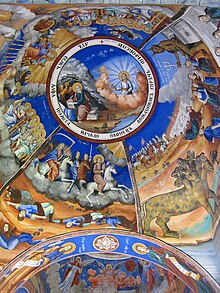
Illustration: Fresco from Osogovo Monastery, Macedonia (Wikimedia Commons)
Tuesday, 27 December 2011

A mystic in New York

"Remember"
If you go to New York, and have any interest either in art or in mysticism, do visit the Nicholas Roerich Museum, tucked away in a brownstone building up on 319 West 107th Street. Roerich was a Russian-born artist, spiritual teacher, and peacemaker – a collaborator with Diaghilev and Stravinsky – whose paintings explore the myths and symbols, the natural beauty, and the spiritual strivings of humanity around the world. The Museum displays approximately two hundred of these

Saturday, 24 December 2011

What's in a landscape?

In a previous post some time ago I mentioned G.K. Chesterton's aversion to impressionism, with which I did not quite agree. I want to look now at some landscape art that I find particularly inspiring, both to recommend it to your attention and to investigate a little for my own sake why I find it so appealing. I begin with a group of artists known as THE GROUP OF SEVEN or Algonquin School, whose work is being exhibited at the Dulwich Picture Gallery until 8 January. Unfortunately I will miss the exhibition, but do go if you can. The artists in this group were born or lived in Canada from the end of the

Wednesday, 21 December 2011

Social network

Billed as the "social network of the JP2 and B16 generations", Ignitum Today seems well worth a visit.